


Research on expatriate stress has identified experiences such as culture shock, insecurity and homesickness as potential sources of stress associated with living abroad (Lei et al., 2004).
There’s a particular kind of loneliness that may not be visible to those back home or around you. It’s the quiet frustration of struggling with everyday things you once did without thinking, such as navigating unfamiliar roads, finding the right grocery store, learning a new language or culture, or simply figuring out where to buy your child’s school uniform.
Suddenly, ordinary life feels unfamiliar, and you wonder when you’ll feel like yourself again.
For some, the constant underlying problem-solving can be exhausting. In conversations with people living abroad, it’s not uncommon to hear that they’re not only managing their own emotions; they’re also carrying the emotional needs of their family. Children may have their own worries, questions and struggles with the transition, leaving you with little space to process your own.
When you’re already emotionally depleted, everyday challenges can feel much harder to manage. For some people living outside their home countries, this quiet, persistent unease can be described as what we might call expat anxiety.
Expat anxiety isn’t a clinical diagnosis. It’s a useful informal term for the anxiety, uncertainty, homesickness, loneliness and emotional strain that some people experience while adapting to life in another country.
Where Anxiety Actually Comes From
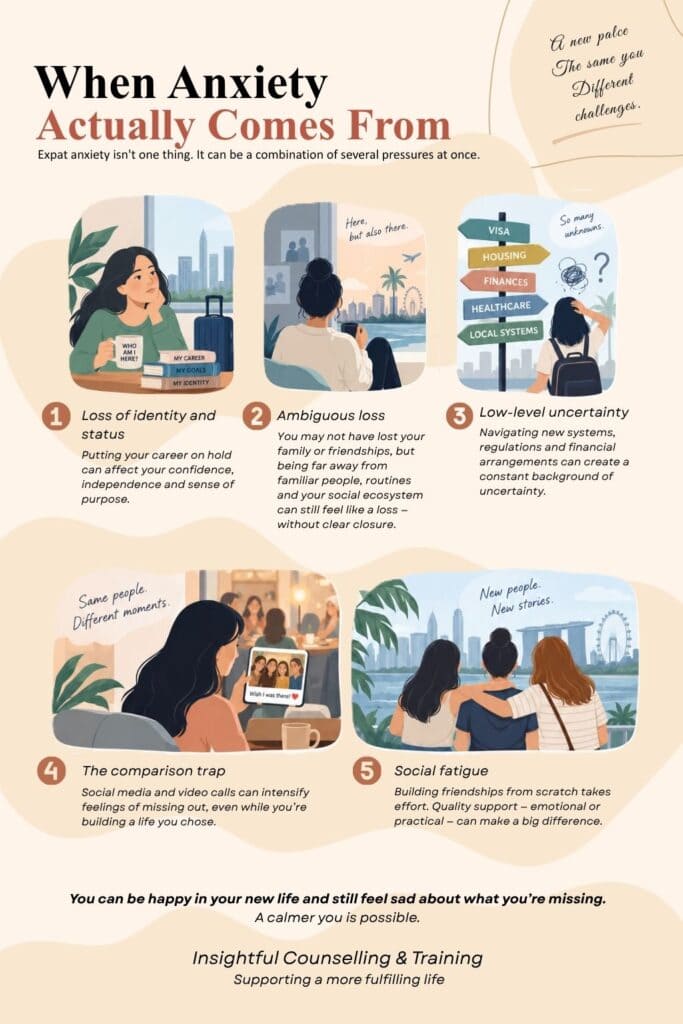
Expat anxiety isn’t one thing. It can be a combination of several pressures at once.
Loss of identity and status. Often described as an accompanying partner (historically, the term “trailing spouse” has also been used), one partner may relocate to support the other’s career, sometimes putting their own professional aspirations on hold. In the Permits Foundation’s 2022 International Dual Careers Survey of 730 spouses and partners across 103 host countries, 53% of partners were not employed in their host country, 84% of those who were not working wanted to work, and 56% said that not working had negatively affected their mental health (Permits Foundation, 2022).
For someone who has built a career and identity of their own, stepping away from work may involve more than losing a salary. For some, it may also affect how a person experiences their confidence, independence, social connection and sense of purpose.
What may look from the outside like an exciting family move can therefore raise difficult questions: Who am I here, beyond being someone’s partner or parent? What happens to the career and identity I built for myself?
Ambiguous loss. Psychologist Pauline Boss uses the term ambiguous loss to describe losses that lack clear closure (Boss, 1999). Relocation can sometimes create a similar experience: you haven’t necessarily lost your family, friendships or previous life, but you may have lost proximity to aging parents, familiar routines, spontaneous friendships and an entire social ecosystem. Because the loss may not be clearly recognised or acknowledged, it can sometimes be difficult to know how to process it (Boss, 1999).
Low-level uncertainty. Navigating unfamiliar systems, regulations and financial arrangements can create a background level of uncertainty (Lei et al., 2004).
The comparison trap. Video calls home can be a double-edged sword. Seeing friends’ birthdays, family dinners and inside jokes you weren’t part of can intensify a sense of missing out, even while you’re living the life you chose.
You can be genuinely happy about your new life and still feel sad about what you’re missing.
Social fatigue. Building friendships from scratch, particularly in a new language or cultural environment, takes effort. Back home, relationships may have developed over years through shared experiences and familiar routines. Abroad, you may need to actively seek people out and repeatedly put yourself in situations where you’re the new person.
Sterle, Vervoort, and Verhofstadt (2018) found that perceived social support was associated with aspects of cross-cultural adjustment among expatriates seeking psychotherapy. Socioemotional support was positively associated with interaction and work adjustment, while instrumental support was linked to better general adjustment among those with greater instrumental support needs (Sterle et al., 2018). For someone living abroad, this highlights the potential value of having people who can provide meaningful emotional or practical support while navigating the challenges of adjustment.
How Counselling Can Help

Talking to a mental-health professional can provide a useful space to explore these difficulties, particularly when relocation begins to affect your relationships, work, sleep, confidence or everyday functioning.
Homesickness, irritability and periods of anxiety can occur during major transitions (Lei et al., 2004). A counsellor can help you understand whether what you’re experiencing may be part of the adjustment process or whether additional support could be helpful.
It can give you language for ambiguous loss. You haven’t necessarily lost a person. You may have lost proximity, routine, status, familiarity or the ease of knowing how things work. Putting these experiences into words can provide a way to understand and explore them.
It offers a neutral space to be honest. Friends back home may unintentionally minimise your struggles, particularly if you previously demonstrated excitement about the move. New friends may not yet have the context to understand what you’ve left behind. Life Transitions Counselling can provide a space where you don’t have to pretend everything is fine.
It can help you develop practical emotional regulation skills. This may include grounding techniques, strategies for managing catastrophic thinking, or other approaches for responding more effectively to difficult emotions.
It can help rebuild a sense of agency. Living abroad can sometimes feel like things are happening to you, rules you didn’t write, systems you don’t yet understand and decisions outside your control. Counselling can provide a space to identify where you do have influence and explore ways to rebuild a sense of confidence and agency.
Working with a counsellor who has experience supporting expats, international movers and people navigating cross-cultural transitions can provide a space where these experiences can be explored without minimising the complexity of adapting to life abroad.
At Insightful Counselling, expat counselling is available in person in Singapore or online, depending on your needs and circumstances.
If living abroad has started to feel heavier than you expected, you don’t necessarily have to navigate that adjustment alone.
References
Boss, P. (1999). Ambiguous loss: Learning to live with unresolved grief. Harvard University Press. https://doi.org/10.4159/9780674028586
Lei, L., Liang, Y. X., & Krieger, G. R. (2004). Stress in expatriates. Clinics in Occupational and Environmental Medicine, 4(1), 221–229. https://doi.org/10.1016/j.coem.2003.12.001
Permits Foundation. (2022). International Dual Careers Survey Report: Partner Survey. Permits Foundation.
Sterle, M. F., Vervoort, T., & Verhofstadt, L. L. (2018). Social support, adjustment, and psychological distress of help-seeking expatriates. Psychologica Belgica, 58(1), 297–317. https://doi.org/10.5334/pb.464