



Why Do Couples Drift Into “Roommate Mode”?
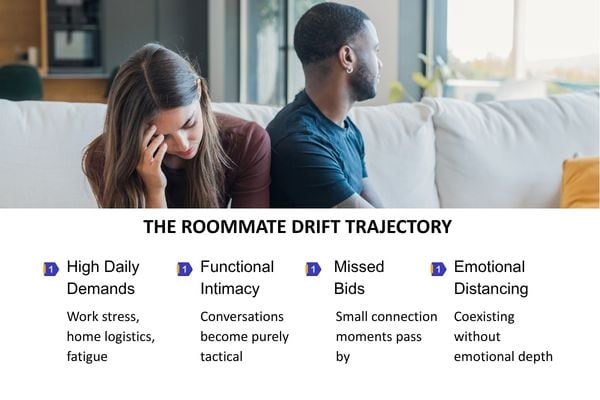
The shift from passionate partners to functional roommates rarely happens overnight. In a fast-paced environment like Singapore, it is often the gradual result of daily micro-decisions and life demands.
-
Transactional Communication: Over time, everyday conversations shift from “How are you feeling about work lately?” to “Did you pick up the groceries?” or “Who is paying the utility bill this month?” Intimacy gets replaced by logistics.
-
Emotional and Physical Fatigue: Long working hours and demanding schedules leave little energy at the end of the day. When energy is low, default scrolling on phones or watching TV separately often replaces meaningful conversation.
-
Avoiding Conflict Through Silence: Some couples don’t fight because they actively avoid bringing up sensitive topics. To keep the peace, they sweep small frustrations under the rug—creating a quiet, invisible wall of emotional distance.
-
Missing “Emotional Bids”: In relationship research (such as the Gottman Method), a “bid” is a small gesture for connection—a glance, a sigh, a comment about an article, or a physical touch. When these bids are consistently missed or ignored due to distraction, partners slowly stop making them.
4 Practical Ways to Reconnect When You’ve Fallen Into a Rut

- Shift from Transactional to Relational Checking-In
– “What was the most stressful part of your day today?”
– “What is something you’re looking forward to this week?”
– “Is there anything on your mind that you haven’t had time to process?”
- Turn Toward Small Bids for Connection
- Schedule “Unstructured” Time Together
- Reintroduce Physical Touch Without Expectation
How Couples Counselling Can Help Reignite the Spark

If you have tried to make changes on your own but still feel stuck and disconnected, getting professional help can move things forward faster.
- Uncover the Root Causes: Identify the specific habits, unspoken resentments, or lifestyle factors that caused the emotional distance in the first place.
- Rebuild Your “Love Maps”: Get to know who your partner is today, including their current stresses, dreams, and emotional needs.
- Break Safe Silence: Talk openly about hidden issues you may have avoided to keep things peaceful. Safely discuss.
- Learn Actionable Tools: Practice research-backed communication techniques to keep emotional closeness alive amid busy routines.
Rediscover Connection with Insightful Counselling
References & Academic Citations
-
Gottman Method & Sound Relationship House:
-
Source: Gottman, J. M., & Silver, N. (2015). The Seven Principles for Making Marriage Work. Harmony Books.
-
Resource Link: The Gottman Institute — Research & Sound Relationship House Framework
-
Application: Applied in reference to identifying “Emotional Bids” and building updated “Love Maps” to foster emotional closeness.
-
-
Cognitive Behavioral Therapy (CBT) for Relationships:
-
Source: Epstein, N. B., & Baucom, D. H. (2002). Enhanced Cognitive-Behavioral Therapy for Couples: A Contextual Approach. American Psychological Association.
-
Resource Link: American Psychological Association (APA) — Book Overview
-
Application: Applied in reference to identifying automatic cognitive assumptions and restructuring negative thought loops into proactive behaviors.
-
-
Transactional Analysis (TA) in Couples Therapy:
-
Source: Berne, E. (1964). Games People Play: The Psychology of Human Relationships. New York: Grove Press.
-
Resource Link: International Transactional Analysis Association (ITAA) — TA Key Concepts
-
Application: Applied in reference to identifying Parent, Adult, and Child ego states during conflict and returning communication to an equal Adult-Adult dynamic.
-