



There is no manual for this. No one hands you a guide when the worst thing happens — when the child you carried hopes for, planned a future around, and loved without condition is gone. And yet men, more than most, often go looking for one. We want to know the right way to do it, as if grief were a task that could be done well or badly, finished correctly or incorrectly. It isn’t. But that doesn’t mean there’s nothing to say about how a man might walk through it.
The Myth of Strength
Many men are raised on a quiet but powerful lesson: that strength means containment. Hold the line. Be the rock for everyone else. Cry alone, if at all. This instinct often comes from love — a father wants to protect his wife, his other children, his parents, from one more ounce of pain. But grief carried entirely in silence doesn’t disappear. It moves underground. It becomes irritability, distance, illness, or a kind of flatness that outlasts the funeral by years.
Strength, in the wake of losing a child, looks different than men are often taught. It isn’t the absence of visible pain. It’s the willingness to stay present to an unbearable thing without running from it — and without making others carry what is yours to feel.
In my work with grieving fathers, I often see men arrive at a first session because a partner gently encouraged them to come. Many say very little for the first few sessions, and it’s not unusual for a man to tell me, weeks in, that this is the first time he has let himself cry in front of another person since the funeral.
Grief Is Not Linear, and It Is Not Identical to Hers
If you are partnered, you may notice that your grief and your partner’s grief don’t match. She may need to talk about your child constantly; you may need silence, or motion, or work. Neither is wrong. Grief does not move in stages that complete on schedule, and it does not move the same way through two people who loved the same child differently.
This mismatch can become its own wound if it isn’t named. A man can begin to believe he is grieving badly because he isn’t grieving the way his partner is, or the way the books describe. He isn’t. He’s grieving the way he is built to grieve, shaped by the relationship he had with his child, by his temperament, by everything he’s never had words for. That is not failure. That is simply the truth of it — there is no single right shape for this. I see this mismatch often in couples who come in together — one partner needing to talk through every detail, the other needing quiet or physical activity to cope. Neither approach is failing the relationship; they are simply two different nervous systems trying to survive the same loss.
Let the Body Speak
Grief doesn’t only live in the mind. It lives in the chest, the jaw, the stomach, the shoulders. Many men find that their grief surfaces first as exhaustion, or anger, or a tightness they can’t name. Physical movement — walking, working with your hands, anything that lets the body process what words can’t yet hold — is not a distraction from grieving. It can be part of it. I hear this often from the fathers I work with: a tight chest before they even know what they’re feeling, restlessness with nowhere to go, or sudden exhaustion that sleep doesn’t touch. The body frequently knows before the mind has language for it.
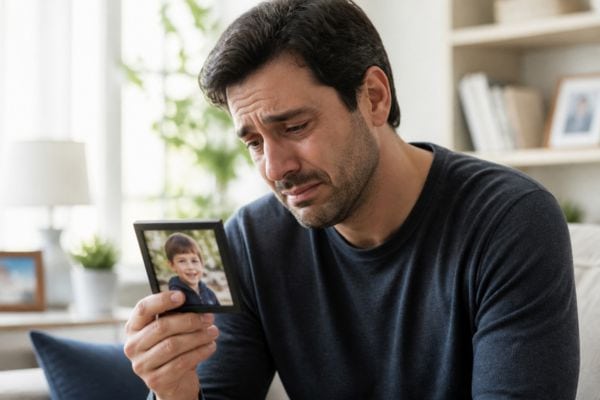
So can stillness. Sitting with a photograph. Visiting a grave without an agenda. Letting a memory arrive uninvited and simply staying with it instead of pushing it away.
You Are Allowed to Talk About It
One of the quieter griefs many fathers carry is this: people stop asking. Friends, coworkers, even family — uncertain of what to say — often go silent on the subject after the first few weeks, as though enough time has passed. It hasn’t. A father’s love for his child doesn’t have an expiration date, and neither does his need to speak of them. This is something I hear constantly in this work: the isolation isn’t only about the loss itself, it’s about watching everyone else’s life carry on while theirs stood still, and having no one left to say their child’s name to.
Say your child’s name. Tell the story of how they laughed, what they were learning to do, who they were becoming. You are not burdening people by remembering out loud — you are honouring someone who lived, however briefly, and who mattered.
If those around you can’t hold this with you, find someone who can: a grief support group for fathers specifically, a counsellor, a friend who has walked this road himself. There is no weakness in needing a witness to your pain.
Anger, Guilt, and the Questions Without Answers
Many men describe anger as the easiest grief emotion to access — easier than sorrow, easier than fear. It can feel more useful, more active. But underneath it is often something raw: guilt over what might have been done differently, helplessness at not having been able to protect your child, or a kind of cosmic injustice that has no answer, no matter how long you interrogate it.
These feelings don’t need to be solved. They need to be allowed. You may never resolve the question of why. Most parents who have lost a child don’t. What changes, over time, isn’t the answer — it’s your relationship to not having one.
Carrying Them Forward

Grieving a child is not about reaching a day when it stops hurting. It’s about learning, slowly and unevenly, how to carry someone you’ll always love in a way that lets you keep living. Some fathers find this through ritual — a yearly tradition, a tree planted, a charity founded in their child’s name. Others find it simply in the way they show up differently for the people still in their lives, gentler, more aware of how fragile and precious it all is.
There is no timeline here, and no finish line. There is only the ongoing, imperfect work of loving someone who is gone — and letting that love change you without destroying you.
If you are in the middle of this now, you are not failing at grief. You are grieving. That is enough.
If you are struggling, you don’t have to carry this alone. Reaching out to a grief counselling at Insightful Counselling, a support group for bereaved fathers, or even one trusted person to talk to can make a real difference.
References:
Buyukcan-Tetik, A., Topal, M. A., Ergun, T. D., Bagci, S. C., Kizilirmak, K., & Boelen, P. A. (2024). Is pregnancy loss (that) disenfranchised? Evidence from a vignette study. European Journal of Psychotraumatology, 15(1). https://doi.org/10.1080/20008066.2024.2398354 Cited by: 3
Lamon, L., De Hert, M., Detraux, J., & Hompes, T. (2022). Depression and post-traumatic stress disorder after perinatal loss in fathers: A systematic review. European Psychiatry, 65(1). https://doi.org/10.1192/j.eurpsy.2022.2326 Cited by: 35
McNeil, M. J., Baker, J. N., Snyder, I., Rosenberg, A. R., & Kaye, E. C. (2021). Grief and Bereavement in Fathers After the Death of a Child: A Systematic Review. Pediatrics, 147(4). https://doi.org/10.1542/peds.2020-040386 Cited by: 122
Stelzer, E.-M., Atkinson, C., O’Connor, M.-F., & Croft, A. (2019). Gender differences in grief narrative construction: a myth or reality? European Journal of Psychotraumatology, 10(1). https://doi.org/10.1080/20008198.2019.1688130 Cited by: 91